|
The origin of Santiago do Cacém
remounts to pre-history, as it was attested by the archaeological researches
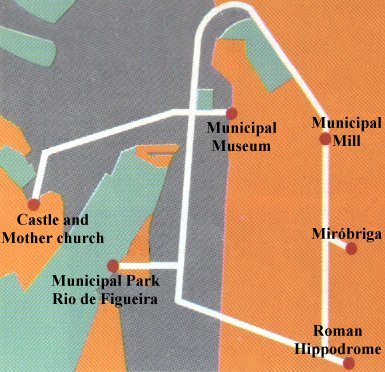
in Castelo Velho, at the top of a hill, east of the borough, where you find
the Roman ruins of Miróbriga. That village from the end of neolithic was
lather fortified by the Celts and in the 3rd and 2nd cent. b.C., it would
already keep important relations with other towns in the south of the
peninsula.
With the Romanization, Miróbriga (a Celtic word) grew and became the center
of an agricultural and cattle breeding area, as proved by its vast
hippodrome. It was also an important watering place (thermae [...]).
The region was invaded by the Germanies and its importance will have
decreased since the 5th cent., at such a pass that the Moslem have founded a
new castle, over the facing hill, at west, wich they called Cacém, probably
because of some alcaide.
Taken by the Templars in 1157, the Moors reconquer it in 1185 but, in the
following year, the Santiago friars win it back.
In 1191, the Moslem regain it, but in 1217 is definitely conquered by the
Christians, and D. Afonso II confirms his father's donation to Santiago
Order, wich explains its name.
Between 1325 and 1336, the castle belonged to the Byzantine princess D.
Vetácia, a chambermaid and friend of the Queen Saint Elizabeth's, and then
returned to the Santiago Order, until 1594, when Filipe II donated it to the
Dukes of Aveiro. In 1759, its possession passed to the crown.
It is a municipality since 1512, when D. Manuel I coceded a "foral"
(charter) to the place.
in: Santiago
do Cacém, ed. da Região de Turismo da Costa Azul, 1991
|